Experiment · Little Bunnies
Two hops reach most of what matters.
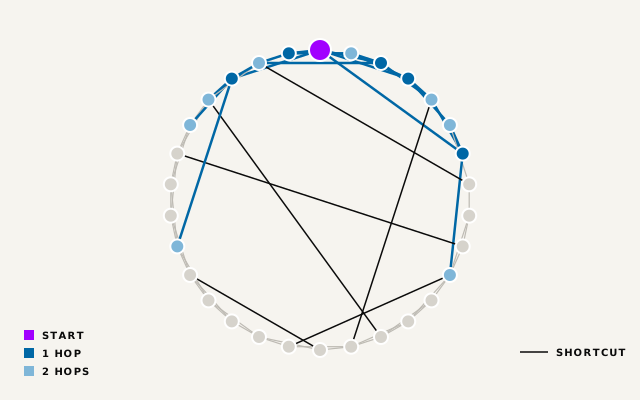
An agent rarely needs the whole graph. In a small-world network, a short neighbourhood around the question already holds most of the connected context, so the agent can stay inside a fixed budget without loading everything.
- Business question
- How much of the graph does an agent need to load to answer well?
- What this shows
- A few long shortcuts make every node close to every other, so reach grows very quickly with each hop.
- Graph contribution
- Hop distance is a natural, explainable limit on what the agent reads.
- Jev control
- Jev works within a fixed state budget. Two hops fill about 70% of it.
Step through it
Watch the neighbourhood grow.
Pick a hop depth to see how much of a 500-node small-world graph is reached from one starting node.
Hop depth
2 hops reach 373 of 500 nodes, 75% of the graph.
- 1 hop 47 nodes, 9%. Only the immediate neighbours. Often too little to connect two facts.
- 2 hops 373 nodes, 75%. Most of the graph, at about 22,380 tokens: roughly 70% of a 32,000-token budget.
- 3 hops 499 nodes, 100%. Effectively everything. The neighbourhood no longer filters anything.
Average path length in this graph is 2.06 hops, which is why the jump from one hop to two is so large.
Methodology
How these numbers were produced.
Model and parametersA synthetic Watts–Strogatz graph, not a measurement of any real catalogue.
- Model
- Watts–Strogatz small-world ring
- Nodes (N)
- 500
- Neighbours (K)
- 25 on each side. NetworkX writes the same ring as k=50 because it counts both directions.
- Rewiring probability
- 0.15, which rewired 1,912 edges
- Random seed
- 1
- Average path length
- 2.06 hops
- Token estimate
- Two hops cover 22,380 tokens, about 70% of a 32,000-token state budget
The illustration at the top of the page is a smaller ring of 30 nodes drawn for legibility; the reach figures come from the 500-node graph.